


`$\newcommand{\N}{\mathbb{N}} \newcommand{\Z}{\mathbb{Z}} \newcommand{\Q}{\mathbb{Q}} \newcommand{\R}{\mathbb{R}} \newcommand{\LP}{\left(} \newcommand{\RP}{\right)} \newcommand{\LS}{\left\lbrace} \newcommand{\RS}{\right\rbrace} \newcommand{\LA}{\left\langle} \newcommand{\RA}{\right\rangle} \newcommand{\LB}{\left[} \newcommand{\RB}{\right]} \newcommand{\MM}{\ \middle|\ } \newcommand{\exp}{\text{exp}} \newcommand{\abs}[1]{\left\vert#1\right\vert} \newcommand{\msr}[1]{m\left(#1\right)} \newcommand{\inv}[1]{#1^{-1}} \newcommand{\bkt}[1]{\LA \img{#1}\RA} \require{color}$`s
The Tanglenomicon name is due to Connolly[1]
Tangle Tabulation in Our Research Group #
The tangle tabulation portion of UIAT works to systematically catalog various types of tangles and their invariants. These efforts aim to create a comprehensive database to serve as a valuable resources for researchers.
Importance of Tabulation Efforts #
Much like protein databases are essential for biologists studying the structure and function of proteins, our tangle databases provide crucial information for understanding the properties and behaviors of tangles and knots. By creating detailed and accurate tables, we provide a foundation for further research, enabling discoveries in theoretical and applied mathematics as well as hard science disciplines such as; physics, chemistry, and biology.
What is a Knot? #
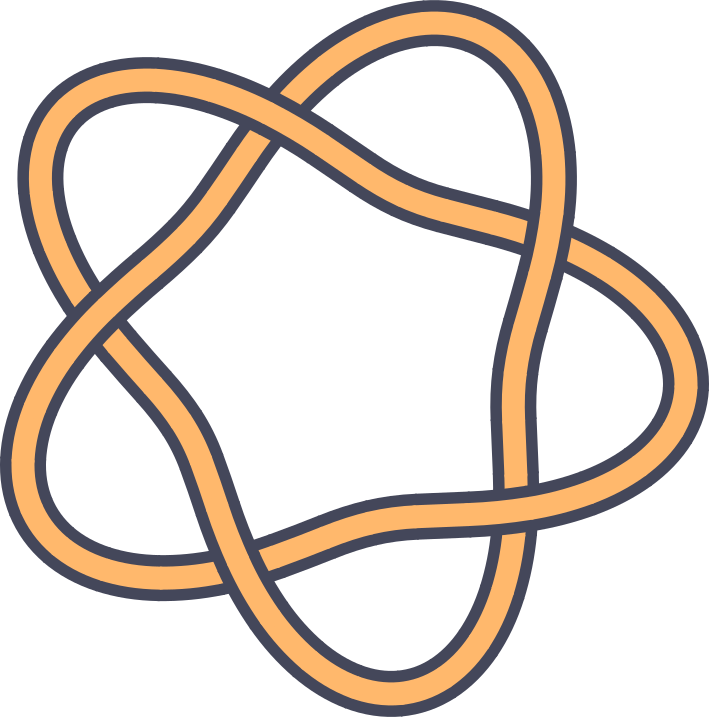
A knot, when used in everyday life, is a tool, whether the “bunny ear” knot holding on your shoe, a decorative monkey’s fist on your keychain, or a climbing hitch securing yourself to a rock wall. These everyday knots are made of a single string with open ends, which can always be untied by pulling on the loops. However, in mathematical knot theory, we consider knots as closed loops in three-dimensional space that do not intersect themselves. Imagine taking a piece of string, tying it into a knot, and then joining the ends together, creating a knot that can be studied mathematically.
History of Knot Tabulation #
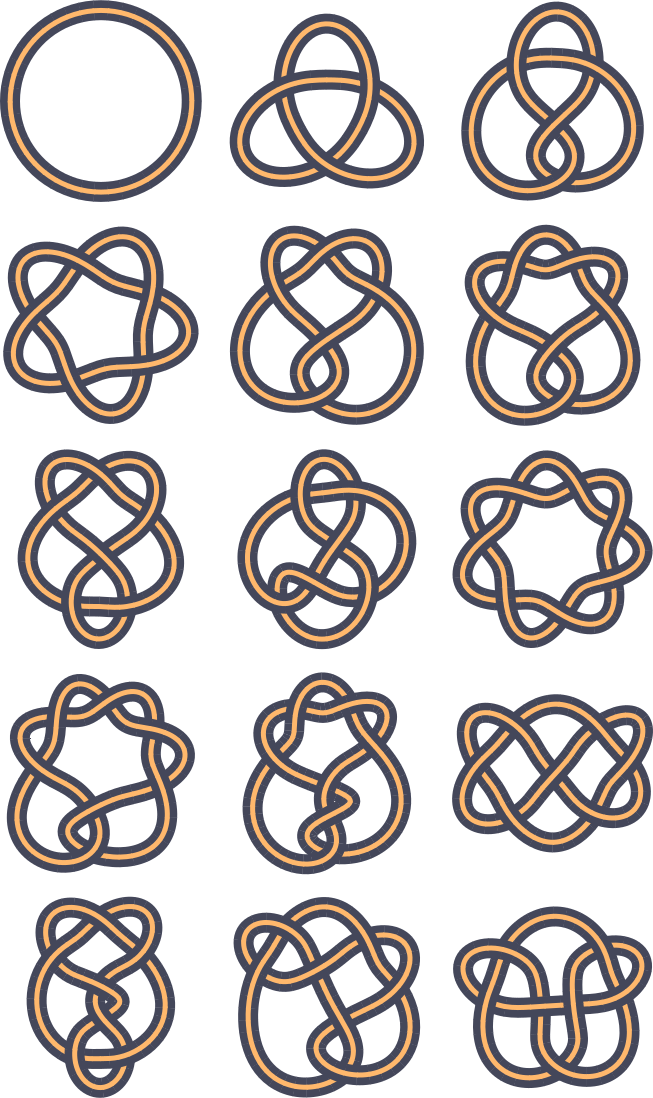
Interest in knot tabulation began in the 1860s, when Lord Kelvin hypothesized that atoms were knotted vortices in the aether. This idea led to the creation of the first knot table by P.G. Tait, who manually computed tables of prime knots up to seven crossings [2]. Tait, along with Kirkman and Little, continued this work for 25 years, eventually publishing a complete list of prime knots up to ten crossings [3][4][5]. Their tables contained a single error, which was corrected in 1974 by Perko, an amateur mathematician [6].
In the 1960s, J.H. Conway introduced [7] a novel approach to knot tabulation by breaking knots into simpler components called tangles. Conway’s tangle calculus made the combinatorial work of knot tabulation more manageable. This approach was later verified and expanded by Caudron, marking the end of the hand computation era.
With the advent of electronic computers in the early 1980s, researchers like Dowker and Thistlethwaite [8] began using computers to construct knot tables. Their two-pass approach, which involved enumerating all knot projections and computing invariants to distinguish them, became the standard for subsequent efforts. Hoste, Thistlethwaite, and Weeks [9] used a similar method to extended knot tables to sixteen crossings in 1998. Burton’s 2020 effort [10] pushed the boundary to nineteen crossings, highlighting the computational challenges of knot tabulation.
What is a Tangle? #
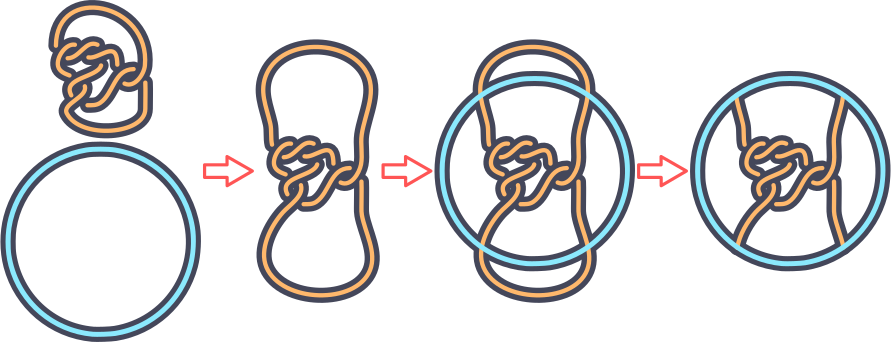
A tangle is a distinct portion of a knot diagram characterized by four arcs extending in the compass directions: northwest (NW), northeast (NE), southwest (SW), and southeast (SE) [7]. This portion is bounded by a Conway circle [7], a Jordan curve intersecting the knot diagram at exactly four points. Tangles serve as fundamental components in knot theory, facilitating the construction and analysis of complex knots [7].
Our Theory

Our Tooling

References #
- N. Connolly, Classification and tabulation of 2-string tangles: The astronomy of subtangle decompositions. University of Iowa, 2021. doi:10.17077/etd.005978
- P. Tait,
The first seven orders of knottiness,
Transactions of the Royal Society of Edinburgh, vol. 32, p. 44, 1884. - P. Tait,
Tenfold knottiness,
Transactions of the Royal Society of Edinburgh, vol. 32, p. 80,81, 1885. - T. Kirkman,
The enumeration, description, and construction of knots of fewer than 10 crossings,
Transactions of the Royal Society of Edinburgh, vol. 32, pp. 80–81, 1885. - C. Little,
On knots, with a census for order 10,
Transactions of the Connecticut Academy Sciences, vol. 7, no. 18, pp. 27–43, 1885. - K. Perko,
On the classification of knots,
Proceedings of the American Mathematical Society, vol. 45, no. 2, pp. 262–266, 1974. doi:10.1090/S0002-9939-1974-0353294-X - J. Conway,
An enumeration of knots and links, and some of their algebraic properties,
in Computational Problems in Abstract Algebra, Elsevier, 1970, pp. 329–358.doi:10.1016/B978-0-08-012975-4.50034-5 - C. Dowker and M. Thistlethwaite,
Classification of knot projections,
Topology and its Applications, vol. 16, no. 1, pp. 19–31, 1983. doi:10.1016/0166-8641(83)90004-4 - J. Hoste, M. Thistlethwaite, and J. Weeks,
The first 1,701,936 knots,
The Mathematical Intelligencer, vol. 20, no. 4, pp. 33–48, 1998. doi:10.1007/BF03025227 - B. Burton,
The Next 350 Million Knots,
LIPIcs, Volume 164, SoCG 2020, vol. 164, pp. 25:1–25:17, 2020. doi:10.4230/LIPICS.SOCG.2020.25